Recent news from Penn Current, Office of University of Pennsylvania, reveals a smartphone medical translation app intended to help avoid healthcare miscommunication in Botswana. The application will be useful when clinicians and patients do not speak the same language and when access to interpreters or translators at the healthcare facility is unavailable.
The app, which is created for use on iPhones and iPads, as well as on phones or tablets with Android operating systems, is devised to prevent problems of communications amongst healthcare workers and their patients that may not speak English but the native language of Setswana.
Ryan Littman-Quinn, director of the BUP’s Mobile Health Informatics program, was able to appreciate the practical use of the app in some U.S. hospitals and clinics, in health settings where doctors, staff and patients encountered difficulties created by language barriers. He became enthusiastic about the idea of using it on a larger scale and decided to develop a similar app for Botswana.
This app was designed by faculty and staff members of the linguistics department at UB that specialize in translation of medical materials and by those involved in the Botswana-UPenn (BUP) Partnership: this is an alliance that formed in 2006 between the University of Pennsylvania School of Medicine and the University of Botswana (UB) to establish research collaborations in medical care, create educational (student exchange and internship) programs, and generate projects aimed at improving health and healthcare education in Botswana.
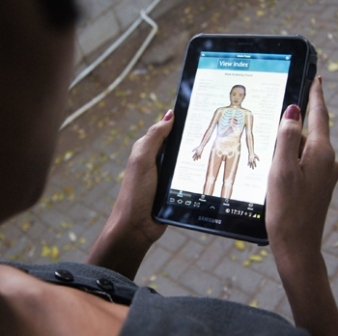
The app is part of the BUP’s capacity-building projects to create an easy-to-use medical translation tool that provides English-Setswana translation content. Thanks to the hard work of a few dedicated UB and Penn medical students, the app, which translates using audio recording pronunciations and a first-ever Setswana dictionary, was created.
After the medical students completed the English-Setswana translation of all terms, vocabulary and phrases, and concluded their editing, coding and testing, the app was then sent to DuoChart, which finalized it and refined the app for use on the field with Botswana patients.
This innovative bilingual Medical Translation Tool app released by DuoChart is now available to download from the Apple app store and Google Play store.
Linguistics believe this and other similar apps will be essential in overcoming the language communication barriers in the Internet age and satisfy the growing needs to have on hand, as well as online, real-time translation tools.
To learn about other mobile applications, be sure to follow TMC’s Medical Software. TMC also has an interesting related read that uncovers how smartphones have become the latest market driver for software language translation.
Edited by
Alisen Downey