A very interesting and tiny new wireless tool has emerged that can be implanted within patients just underneath the skin that is able to safely and accurately monitor as many as five different blood conditions. Truth be told, it isn't all that different than implanting a tracking device in your pet that contains the owner's information, that can in turn be read in the case your pet is lost.
Of course, the new device isn't merely a passive tool that holds some information. Rather, it is a far more complicated and sophisticated sensor. And far more importantly, it can lead to actually saving human lives.
What is it? It is a new device that is able to monitor five blood-based proteins and organic acids simultaneously that are used when monitoring patients for conditions related to heart attacks and diabetes, among others, though these two are specifically the current research targets for the new device. Still in the trial and testing stages the device has been shown to provide, at the very least, the same levels of reliability that traditional blood tests currently provide.
The key difference however is that the device monitors the substances in real-time and even reports real-time results, whereas blood tests need to have blood samples drawn and then tested externally. Blood tests typically take some time to conduct and are certainly not able to deliver the on-the-spot information that the new device delivers. Further, blood tests are typically reactive to events. The new device lends itself to the same post-event monitoring, however because of its instantaneous and constant monitoring, it is also able to predict events such as a hard attack or a potential diabetic episode ahead of these events taking place.
This is a critical change in patient care that turns reactive behavior into the kind of proactive behavior that can truly result in saving lives.
The new device - which as far as we know does not yet have a name associated with it, and the research results that underpin it were announced and presented on March 20, 2013 at Europe’s largest electronics conference, DATE 13. The device was developed by a team of Ecole Polytechnique Fédérale de Lausanne (EPFL) scientists led by Giovanni de Micheli and Sandro Carrara and made up of doctors, electronics experts, biologists and computer scientists.
The implant is a rather astounding design that includes five sensors, a radio transmitter and a power delivery subsystem. Shown below being held between a set of tweezers, it is only 14 mm long.
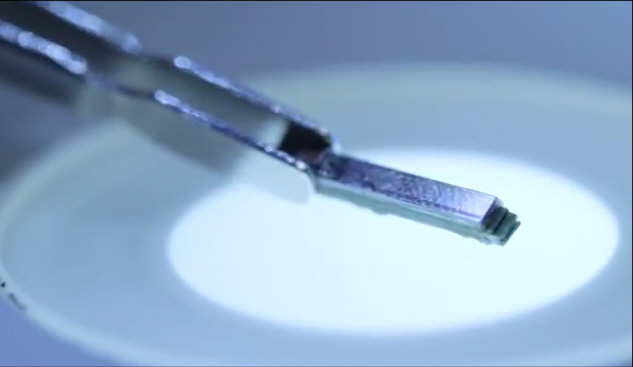
The electronics that form the foundation of the device posed a considerable challenge - the system needed to work on nothing more than a tenth of a watt of power, and was further complicated by the need to develop the micro-electrical coil that receives that tenth of a watt of power from an external patch. The implant itself does not contain a power source. Instead, it is activated through wireless induction charging (more or less the same as how wirelessly charging a smartphone works) using the external patch just noted. Once activated and powered, the implanted device transmits its data via RF to the patch.
The patch in turn then transmits collected data to a mobile device via Bluetooth. Depending on where the patch is transmitting to, the mobile device can be the end point of the transmission but it can certainly also be delivered further down a pipeline to other devices. For example, from a patient's smartphone to a Website and then to a doctor's iPad.
Gathering the Human Data
The technology would be amazing if things ended there, but there is also the technology involved in monitoring the blood itself and extracting the necessary data from it. The device is pushing the current limits by monitoring five substances. How does it accomplish this? Each sensor is treated with a certain enzyme that reacts with the particular blood-based substance or chemical being monitored. This process is non-trivial - the enzymes have to be carefully selected to ensure they last as long as possible before they begin to break down and the implant needs to be replaced.
Giovanni de Micheli notes, “Potentially, we could detect just about anything. But the enzymes have a limited lifespan, and we have to design them to last as long as possible. The enzymes currently being tested are good for about a month and a half, which is already long enough for many applications.”
It is certainly possible to develop multiple implant devices, with each of them geared to specific medical needs, such as monitoring how a patient reacts to certain medications, medication doses, and other treatments such as chemotherapy. The larger goal is to deliver capabilities that will create significantly more enhanced and directly personalized medical care.
In fact, these needs do not necessarily need to be medical in the sense of treating patients. They can just as easily serve to monitor athletes, gauge the effects and results of such things as doing certain exercises, certain vitamins, or…the list is in fact endless.
Implants do not necessarily need to be permanent though they can be (relative to being replaced as needed and required by the enzyme coatings). It all depends on what the exact need is. Over time, we may see enzymes developed that will last longer than six weeks, but since the implants are easy to remove and replace this isn't a limiting issue.
All of that said, the current focus is on detecting heart attack and diabetic conditions and monitoring for them both pre- and post-heart or diabetic attacks. If conditions are being monitored in real-time within a medical setting, treatments can quickly be administered in near-real time as well. At the very least, symptoms can be monitored and detected in high risk though not imminent cases and emergency medical teams might, for example, be dispatched to a patient's home.
Per the research team, it is anticipated that the device will be ready for commercial deployment within four years. That may seem like ages, but in fact it is just around the corner. The following video provides some very interesting additional details on the new device.
Edited by
Jamie Epstein